
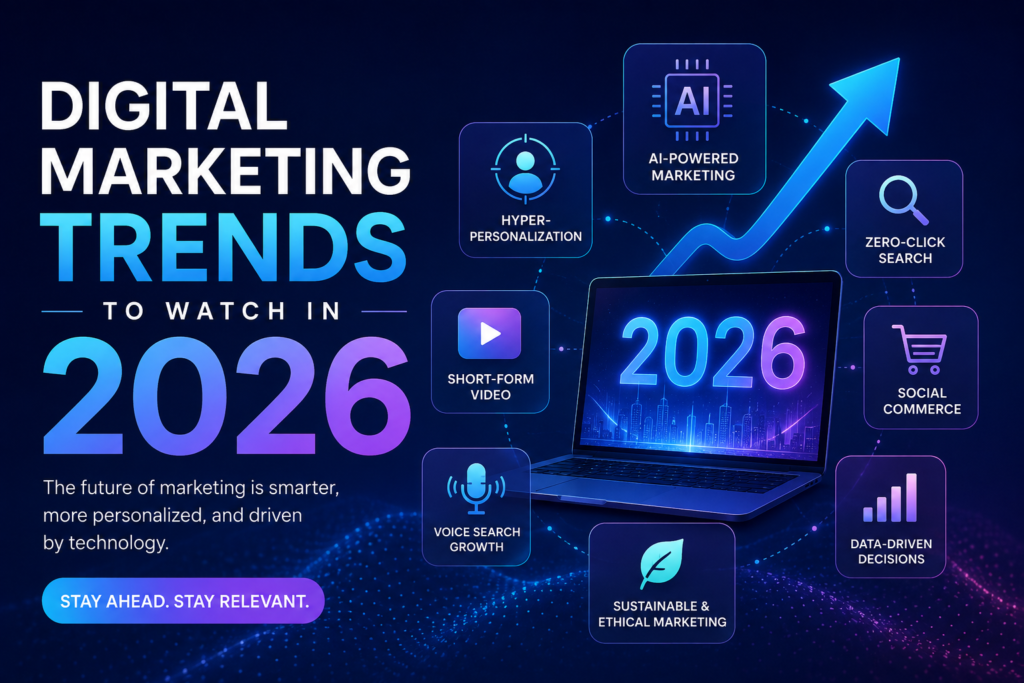
Digital marketing is changing faster than ever. New technologies, changing consumer behavior, artificial intelligence, privacy expectations, and evolving social platforms are transforming the way businesses attract and engage customers.
In 2026, digital marketing is no longer simply about ranking on Google, posting regularly on social media, or running online advertisements. Businesses are increasingly competing for attention across search engines, AI assistants, social platforms, messaging apps, websites, and digital communities.
The biggest shift is that AI is moving from an experimental marketing tool to an everyday part of marketing operations. At the same time, first-party data, personalized experiences, short-form video, and authentic content are becoming increasingly important. Industry research also shows marketers are focusing more strongly on connecting data, activation, and measurable business outcomes.
Here are the major digital marketing trends to watch in 2026.
1. AI-Powered Marketing Becomes the New Normal
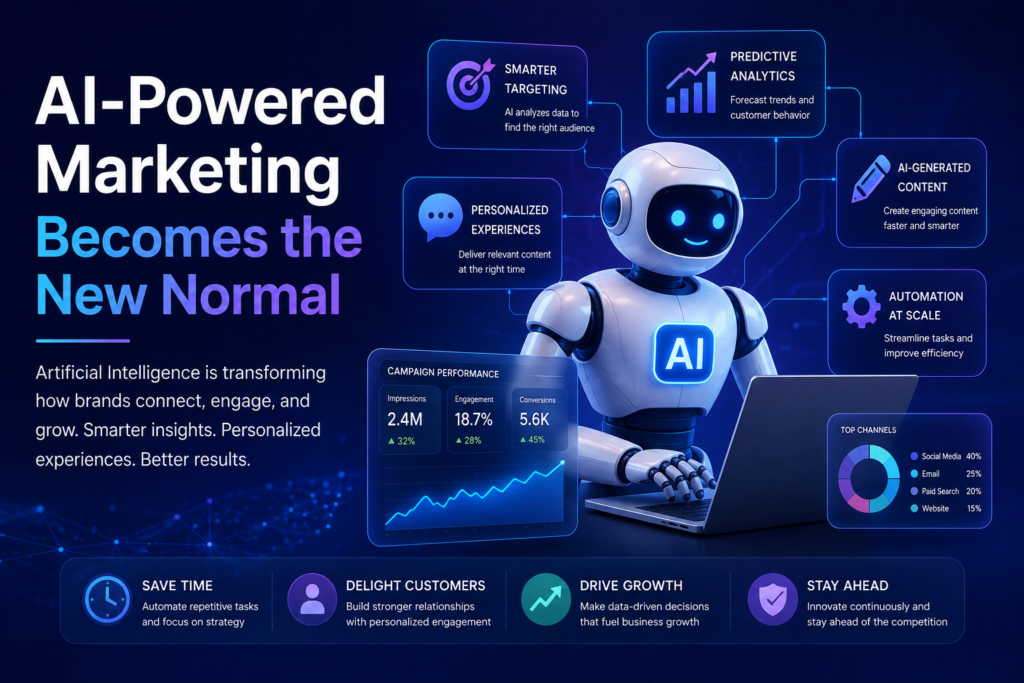
Artificial intelligence is one of the biggest forces shaping digital marketing in 2026.
Marketing teams are using AI to brainstorm ideas, analyze customer behavior, personalize campaigns, create content, automate repetitive tasks, and improve advertising performance. According to Experian’s 2026 trends report, 94% of marketers are investing broadly in AI to improve efficiency and impact.
However, AI is not simply replacing marketers. Instead, it is becoming a powerful assistant.
For example, an AI system can help a marketer analyze thousands of customer interactions and identify patterns that would be difficult to find manually. It can also help create different versions of an advertisement for different audiences.
The marketers who succeed in 2026 will be those who combine AI efficiency with human creativity, strategy, judgment, and brand understanding.
2. AI Search and Answer Engine Optimization Will Change SEO
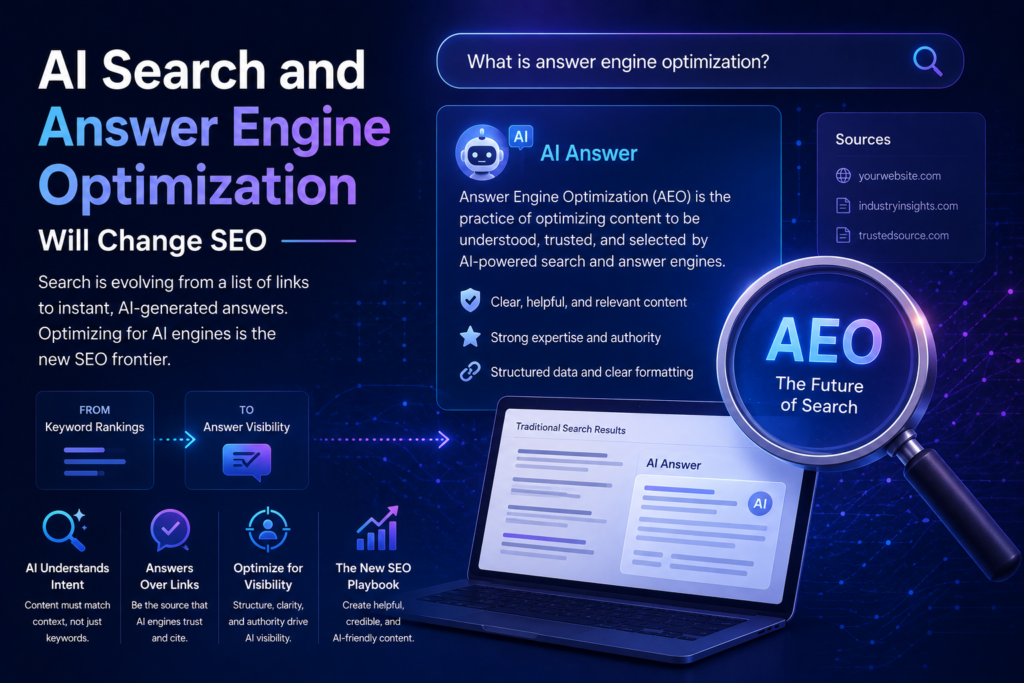
Search is evolving from traditional lists of links toward AI-generated answers.
Consumers are increasingly asking AI-powered search tools questions and receiving summarized answers instead of clicking through multiple websites. HubSpot’s 2026 marketing research identifies optimizing content for AI search as one of the major priorities for marketers.
This is creating a new area of optimization often called Answer Engine Optimization (AEO) or Generative Engine Optimization (GEO).
Traditional SEO is still important, but businesses now need to make their content easy for AI systems to understand, evaluate, and reference.
This means creating:
- Clear and authoritative answers
- Well-structured web pages
- Original research and insights
- Frequently asked questions
- Helpful, specific content
- Accurate business information
- Strong author and brand credibility
Website performance also matters. Recent reporting suggests that technically strong websites with clear structures can be easier for AI systems to crawl and interpret.
In 2026, the goal is no longer just to rank on a search-results page. Businesses increasingly need to become a trusted source that AI-powered search systems can understand and recommend.
3. First-Party Data Will Become More Valuable
Data is one of the most important assets in modern marketing.
As privacy expectations increase and traditional third-party tracking becomes less dependable, businesses are placing greater importance on first-party data — information collected directly from their customers with appropriate permission.
Examples include:
- Email subscribers
- Customer accounts
- Website interactions
- Purchase history
- Loyalty-program information
- Customer preferences
- Voluntarily provided survey information
Experian reports that 70% of B2B marketers plan to increase their use of first-party data.
The advantage is simple: businesses have a stronger understanding of their own customers without depending entirely on external advertising platforms.
In 2026, successful brands will focus on building valuable customer relationships rather than simply collecting as much data as possible. Transparency, consent, security, and responsible data use will be essential.
4. Personalization Will Become More Intelligent
Consumers expect brands to understand their interests.
Generic advertisements and identical messages for everyone are becoming less effective. AI makes it possible for businesses to personalize marketing experiences on a much larger scale.
For example, an online store could recommend products based on a customer’s previous interactions. An email campaign could automatically adjust its content based on customer interests. A website could display different content depending on where a visitor is in the buying journey.
However, personalization should be useful rather than intrusive.
The best personalization feels relevant and helpful — not like a company is monitoring every action a person takes.
In 2026, businesses will increasingly combine AI with first-party data to create more relevant customer experiences while maintaining responsible data practices.
5. Short-Form Video Will Continue to Dominate Attention
Short-form video remains one of the most powerful formats for digital marketing.
People increasingly consume quick, visual content because it is easy to understand and share. Brands are using short videos to educate audiences, demonstrate products, tell stories, answer questions, and build awareness.
But there is an important change: authenticity matters more than expensive production.
Audiences are becoming more familiar with highly polished advertising. Simple videos that feel genuine, useful, entertaining, or relatable can often create stronger connections.
Businesses should experiment with:
- Educational videos
- Behind-the-scenes content
- Product demonstrations
- Customer stories
- Quick tutorials
- Frequently asked questions
- Industry tips
- Short interviews
The objective should not be to create videos simply because video is popular. Every video should provide a reason for the audience to watch.
6. Social Media Will Become More Search-Oriented
Social media is no longer only a place for social interaction. It is increasingly becoming a discovery tool.
People use social platforms to discover products, learn new information, research businesses, and find recommendations.
This means marketers need to think about social search optimization.
Instead of relying only on hashtags, brands should use descriptive captions, relevant keywords, clear titles, useful information, and content that directly answers common questions.
For example, rather than creating a generic post about a product, a business could create a short video answering: “How do you choose the right product for beginners?”
That content has a clear search intent and provides immediate value.
7. Influencer Marketing Will Shift Toward Trust
Influencer marketing is evolving.
Instead of focusing only on celebrities and large influencers with millions of followers, many brands are increasingly interested in creators who have smaller but highly engaged communities.
Micro- and niche creators can offer something extremely valuable: trust.
A creator who consistently talks about a particular subject may have a stronger relationship with their audience than a celebrity promoting hundreds of unrelated products.
In 2026, brands should evaluate creators based on factors such as audience relevance, engagement quality, credibility, content style, and alignment with brand values — not simply follower count.
Authentic partnerships are likely to produce better long-term results than one-off promotional posts.
8. Conversational Marketing Will Grow
Customers increasingly expect quick answers.
Instead of filling out long forms or searching through multiple pages, people want to communicate directly with businesses.
Conversational marketing uses tools such as chat interfaces, messaging, AI assistants, and automated customer-service systems to make communication easier.
The goal is not to remove humans from customer service. Rather, automation can handle simple questions while human employees focus on complex situations.
For example, an automated system could answer basic questions about opening hours, delivery status, or product information, while a customer-service representative handles a more complicated request.
This combination of automation and human support can create a faster and more convenient customer experience.
9. Content Quality Will Matter More Than Content Quantity
Generative AI has made it easier to produce large amounts of content.
But this creates a new problem: the internet is becoming increasingly crowded with repetitive, generic material.
As a result, simply publishing more articles will not guarantee success.
Businesses need to produce content that offers something genuinely useful.
High-quality content should demonstrate:
- Original ideas
- Real expertise
- Practical examples
- Clear explanations
- Reliable information
- Strong storytelling
- A distinctive brand voice
AI can help with research, organization, and drafting, but human expertise remains essential.
The winning strategy in 2026 will not be “create more content.” It will be create more valuable content.
10. Privacy and Trust Will Become Competitive Advantages
Digital marketing depends on customer trust.
Consumers are increasingly aware that their information has value. Businesses therefore need to be transparent about how customer information is collected and used.
Privacy should not be treated simply as a legal requirement. It can become part of a company’s reputation.
Brands that communicate clearly, request appropriate permissions, protect customer information, and avoid manipulative practices can build stronger relationships.
In an environment where AI can generate content and advertisements at enormous scale, trust may become one of the strongest ways for a brand to differentiate itself.
11. Marketing Measurement Will Focus More on Business Results
Marketing teams are under increasing pressure to demonstrate results.
Vanity metrics such as impressions, likes, and follower counts can be useful, but they do not always tell businesses whether marketing is creating real value.
In 2026, marketers will increasingly focus on metrics such as:
- Customer acquisition cost
- Conversion rate
- Return on advertising spend
- Customer lifetime value
- Revenue generated
- Retention rate
- Lead quality
- Incremental sales
Experian’s 2026 outlook highlights the growing connection between activation and measurement, showing how marketers are moving toward more integrated performance management.
The question is changing from “How many people saw our campaign?” to “What business outcome did the campaign create?”
12. The Human Side of Marketing Will Become More Important
Perhaps the most interesting trend of 2026 is that technological progress is making human connection more valuable.
AI can generate text, images, ideas, and analysis at incredible speed. But technology cannot automatically create genuine trust between a brand and its customers.
People still respond to stories, emotions, experiences, communities, and authentic voices.
As AI-generated content becomes more common, original human perspectives can become a powerful differentiator.
The future of digital marketing is therefore not simply AI versus humans.
It is AI plus humans.
AI can provide speed, scale, and analysis. Humans provide creativity, empathy, judgment, strategy, and cultural understanding.
Conclusion
Digital marketing in 2026 is being shaped by a combination of technology and changing customer expectations.
AI-powered marketing, AI search, first-party data, personalization, short-form video, social search, creator marketing, conversational experiences, privacy, and better measurement are among the biggest trends businesses should watch.
But marketers should not chase every new trend.
The most successful strategy is to understand where customers spend their time, how they search for information, what they value, and what problems they need solved.
Businesses that combine smart technology with high-quality content, responsible data practices, authentic communication, and measurable results will be better positioned for long-term growth.
The digital marketing landscape will continue to evolve. The brands that adapt quickly — while keeping the customer at the center — will be the ones most likely to stand out in 2026 and beyond.