
In today’s digital world, advertising online has become one of the most effective ways for businesses to reach potential customers. Whether you run a small business, an online store, a personal brand, or a large company, paid advertising can help you increase visibility, attract customers, and generate sales.
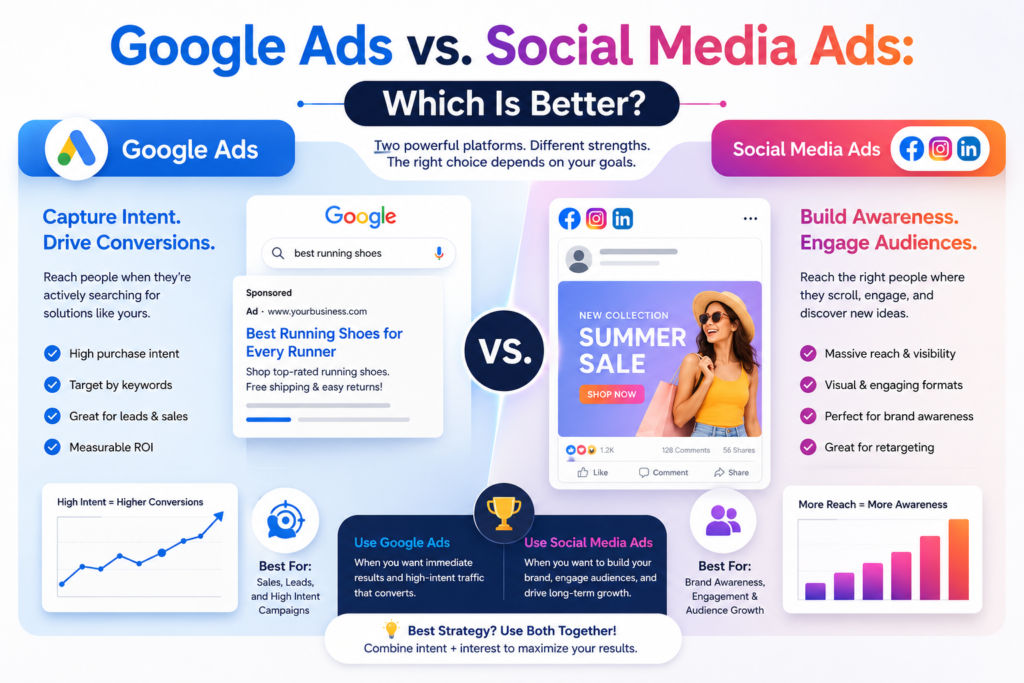
Two of the most popular forms of online advertising are Google Ads and Social Media Ads. Both can deliver excellent results, but they work in very different ways.
Google Ads generally helps businesses reach people who are already searching for a product, service, or solution. Social media advertising, on the other hand, allows businesses to reach people based on characteristics such as interests, behavior, demographics, and online activity.
So, which one is better?
The answer depends on your business goals, target audience, budget, product, and marketing strategy. In many cases, the best approach is not choosing one over the other but using both strategically.
Let’s explore the differences between Google Ads and Social Media Ads.
What Are Google Ads?
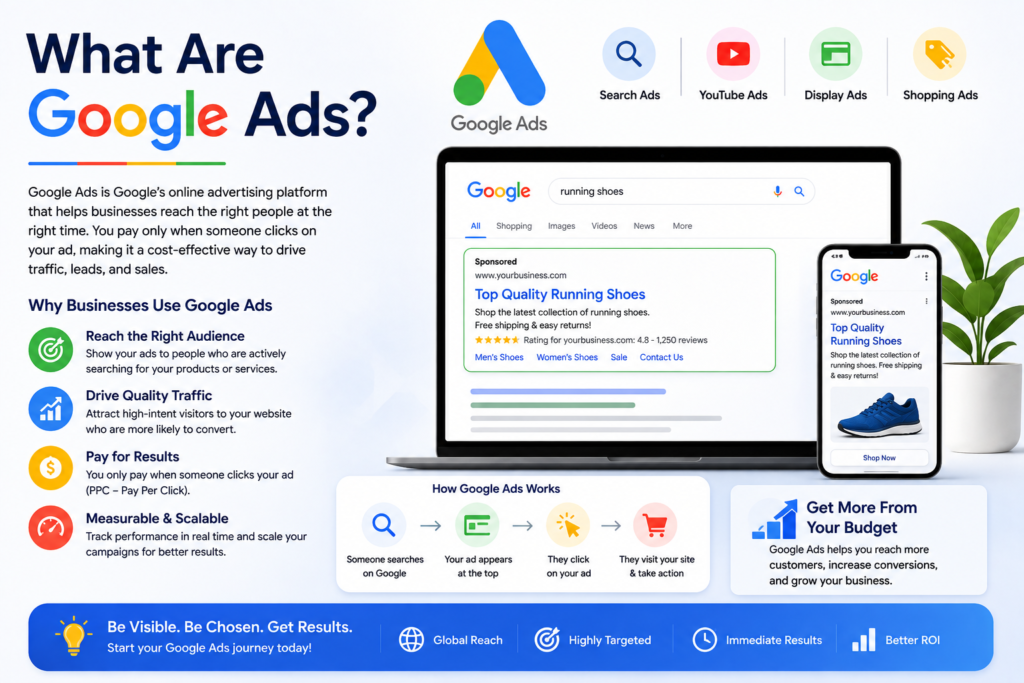
Google Ads is Google’s online advertising platform. Businesses can use it to promote their products and services across Google’s advertising network.
One of the most well-known formats is search advertising. These ads can appear when users search for particular keywords on Google.
For example, imagine someone searches:
“best digital marketing agency near me.”
A company offering digital marketing services could create a Google Search ad targeting relevant search terms.
Google also offers other advertising formats, including display advertising, video advertising, shopping campaigns, and other campaign types.
The major advantage of Google Ads is search intent.
People using Google Search are often actively looking for information, products, or services. This can make search advertising particularly effective for businesses that want to capture existing demand.
Social media advertising involves paying to promote content, products, services, or messages on social networking platforms.
Popular social advertising platforms include Instagram, Facebook, YouTube, TikTok, LinkedIn, and other networks.
Unlike search advertising, social media advertising does not necessarily wait for someone to search for a product.
Instead, advertisements can appear while people are browsing their social feeds, watching videos, exploring content, or interacting with communities.
For example, a clothing company could show an advertisement to users who have demonstrated an interest in fashion.
This makes social media advertising particularly useful for discovering and reaching potential customers who may not yet be actively searching for a product.
Google Ads vs. Social Media Ads: The Main Difference
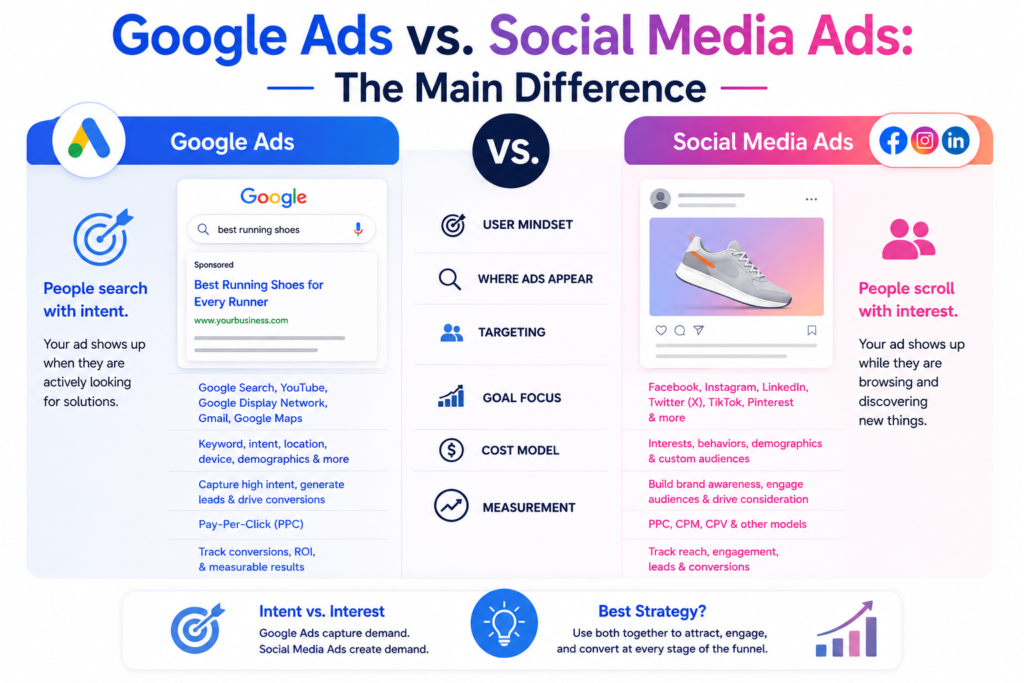
The key distinction between the two is the intention behind the user’s search.
Google Ads often captures existing demand.
Social media ads often help create or stimulate demand.
Consider two situations.
A person searches Google for “buy running shoes online.” They already know what they want and may be ready to purchase.
Another person is scrolling through Instagram and sees an advertisement for a new pair of running shoes. They were not necessarily planning to buy shoes, but the advertisement may create interest.
Both situations can lead to a sale, but the customer journey is different.
Targeting Capabilities
Targeting is an important part of digital advertising.
Google Ads allows advertisers to target people based on factors such as keywords, location, language, audience signals, and other campaign settings.
Search advertising is especially powerful because the keyword itself can provide valuable information about what the user wants.
Social media platforms offer different targeting opportunities. Advertisers can often build audiences based on demographics, interests, behaviors, engagement, and other available signals.
For example, a business selling educational products might want to reach an audience interested in education and learning.
Social media can therefore be extremely useful for reaching specific groups and introducing products to new audiences.
Cost: Google Ads vs. Social Media Ads
There is no universal answer to which platform is cheaper.
Advertising costs can vary depending on:
- Industry
- Competition
- Audience
- Location
- Keywords
- Ad quality
- Campaign objective
- Season
- Platform
- Bidding strategy
Google Ads often operates through an auction system in which advertisers compete for opportunities to show their ads.
Highly competitive keywords can be expensive because many businesses want to appear for the same searches.
Social media advertising also uses auction-based systems, and costs can vary according to audience competition and campaign objectives.
Therefore, instead of asking, “Which platform is cheaper?”, businesses should ask:
“Which platform produces better results for my specific goal?”
An inexpensive campaign that produces no customers is not necessarily better than a more expensive campaign that generates profitable sales.
Advantages of Google Ads
1. Reaches People With Strong Intent
One of the biggest strengths of Google Search Ads is that they can reach people who are actively searching for something.
This is especially useful for businesses selling products or services that people regularly search for.
2. Can Generate Fast Traffic
Once a campaign is approved and running, advertisements can begin appearing for relevant searches.
This can provide faster visibility than waiting for organic SEO rankings.
3. Useful for Local Businesses
Local businesses can use search advertising to reach people searching for nearby products and services.
For example:
- “dentist near me”
- “best restaurant nearby”
- “computer repair near me”
This makes Google Ads useful for businesses that depend on local customers.
4. Strong Intent-Based Targeting
Keywords provide valuable information about what users are looking for.
This allows businesses to create advertisements that directly address the searcher’s needs.
Disadvantages of Google Ads
Google Ads also has limitations.
High Competition
Some industries have highly competitive keywords, which can increase advertising costs.
Requires Optimization
Simply creating an advertisement does not guarantee good results. Businesses need to monitor campaigns, keywords, landing pages, conversions, and other performance factors.
Traffic Can Stop When Spending Stops
Paid search campaigns generally require continued advertising investment to maintain paid traffic.
Advantages of Social Media Ads
1. Excellent Audience Discovery
Social media allows businesses to reach people who may not yet know about their products or services.
This makes it useful for building awareness and introducing new brands.
2. Strong Visual Opportunities
Social platforms are particularly useful for visual content.
Businesses can use:
- Images
- Short videos
- Stories
- Carousels
- Demonstrations
- Product showcases
Visual content can help brands communicate their message quickly.
3. Useful for Brand Building
Social advertising is not only about immediate sales.
Businesses can use advertisements to increase brand awareness, introduce products, build communities, and remain visible to potential customers.
4. Retargeting Opportunities
Businesses can often create campaigns designed to reconnect with people who previously interacted with their website, content, or brand, subject to the platform’s available targeting and privacy controls.
For example, someone might visit an online store without purchasing. A business could use an appropriate retargeting campaign to encourage that person to return.
Disadvantages of Social Media Ads
Users May Not Have Purchase Intent
People often use social media for entertainment or communication rather than shopping.
Someone seeing an advertisement may not be ready to purchase.
Creative Fatigue
Users may become less responsive when they repeatedly see the same advertisement.
Businesses often need to refresh their creative content.
Platform Dependence
Social advertising depends heavily on the rules, algorithms, audience behavior, and advertising systems of individual platforms.
Which Is Better for Brand Awareness?
If your main goal is brand awareness, social media advertising can be a strong choice.
Social platforms are designed around content discovery and engagement. Businesses can use video, images, stories, and other creative formats to introduce their brands to new audiences.
For example, a new clothing brand could use short videos to showcase its products and establish its visual identity.
Google Ads can also support brand awareness, particularly through display and video advertising, but social media often provides more opportunities for creative storytelling.
Which Is Better for Sales?
For direct sales, the answer depends on the product and customer journey.
Google Search Ads can work well when people already know what they want.
For example, someone searching for:
“buy wireless headphones online”
may have strong purchase intent.
Social media ads can also be highly effective for sales, especially when the product is visually appealing or benefits from discovery.
An attractive product demonstration can turn a social media user into a potential customer even when they were not originally searching for the product.
Which Is Better for Small Businesses?
Small businesses should choose based on their specific audience and objectives.
A local service business, such as a repair company, may benefit greatly from Google Search Ads because potential customers often search for services when they need them.
A fashion, beauty, food, or lifestyle brand may benefit significantly from social media advertising because visual content can help showcase products.
Before spending a large amount of money, small businesses should test campaigns with a controlled budget and measure the results.
Google Ads vs. Social Media Ads: Comparison
| Factor | Google Ads | Social Media Ads |
| Main strength | Capturing search demand | Creating awareness and demand |
| User intent | Often high | Varies |
| Targeting | Keywords, location, audiences, etc. | Demographics, interests, behaviors, audiences, etc. |
| Content formats | Search, display, video, shopping, etc. | Images, videos, stories, carousels, etc. |
| Best for | Search-driven products and services | Discovery, awareness, engagement, and visual products |
| Brand awareness | Good | Excellent potential |
| Immediate intent | Strong for relevant searches | Usually lower |
| Creative flexibility | Moderate to high | High |
| Local advertising | Strong | Strong |
| Retargeting | Available | Available |
Should You Use Both?
For many businesses, using both Google Ads and Social Media Ads can create a stronger marketing strategy.
Think of the customer journey.
Social media advertising can introduce a person to your brand.
Later, that person might search Google for your company or product.
Google Ads can then help capture people who are actively searching for what you offer.
For example:
Social media → Brand awareness → Website visit → Google search → Purchase
This means the two channels do not always compete with each other. They can support different stages of the customer journey.
How to Choose the Right Platform
Before choosing an advertising platform, answer these five questions:
1. What Is Your Goal?
Do you want:
- Brand awareness?
- Website traffic?
- Leads?
- App downloads?
- Online sales?
- Local customers?
Your goal should determine your campaign strategy.
2. Where Is Your Audience?
Find out where your target customers spend time online.
If they frequently search for solutions on Google, search advertising may be valuable.
If they spend significant time on social platforms discovering products and content, social advertising may be more suitable.
3. What Are You Selling?
Some products require customers to actively search for them.
Others are easier to discover visually.
Understanding the buying journey can help you select the right platform.
4. What Is Your Budget?
Start with a realistic budget that allows you to test your campaigns.
Do not spend heavily before you understand which audiences, advertisements, and landing pages are producing results.
5. What Results Are You Getting?
Use measurable business metrics rather than focusing only on likes, clicks, or impressions.
Important metrics can include:
- Conversion rate
- Cost per lead
- Cost per acquisition
- Revenue
- Return on ad spend
- Customer lifetime value
Final Verdict: Google Ads or Social Media Ads?
So, which is better?
Neither is universally better.
Google Ads is particularly powerful for capturing existing demand. It can help businesses reach people who are actively searching for products, services, or information.
Social media advertising is particularly powerful for discovery, awareness, engagement, and visual storytelling. It can help businesses introduce products to people who may not yet be searching for them.
The best choice depends on your business goals, audience, product, budget, and customer journey.
For many businesses, the strongest strategy is to combine both.
Use Social Media Ads to attract attention and build interest, and use Google Ads to capture people who are actively searching and ready to take action.
Ultimately, successful digital advertising is not about choosing the most popular platform. It is about choosing the platform that reaches the right people, with the right message, at the right stage of their journey — and then measuring the results carefully.
The winning strategy is not Google Ads vs. Social Media Ads. It is using the right channel for the right purpose.