
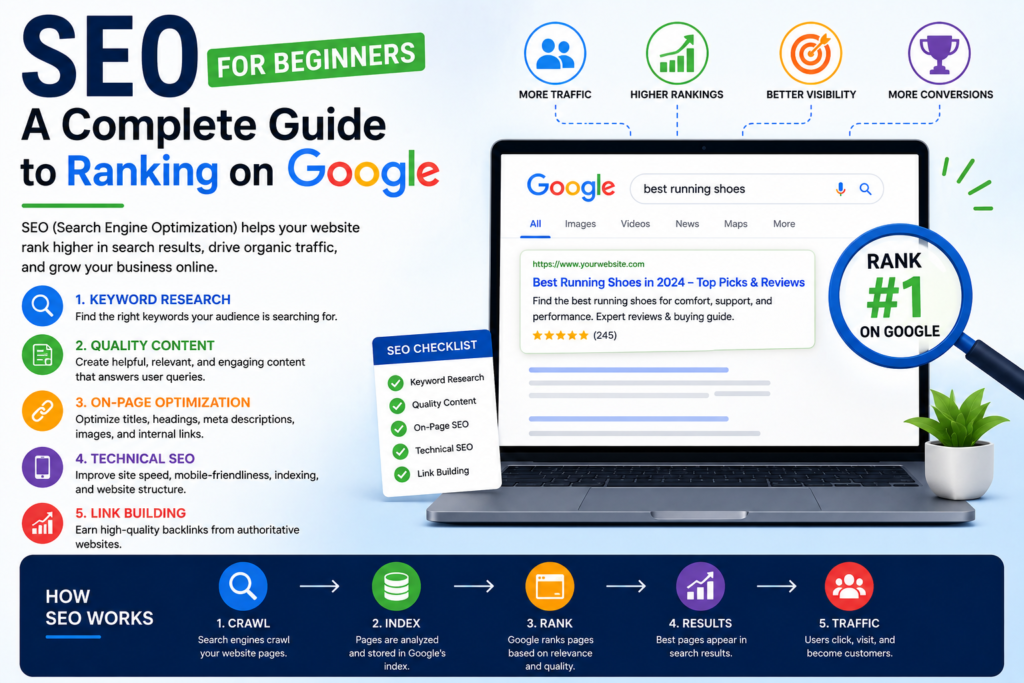
If you have a website, blog, online store, or business, you probably want people to find it on Google. But with millions of websites competing for attention, simply publishing a webpage is not enough. This is where Search Engine Optimization (SEO) becomes important.
SEO is the process of improving your website and its content so that search engines can better understand it and users can discover it through relevant searches. When done correctly, SEO can help your website attract visitors without having to pay for every click.
For beginners, SEO can seem complicated because it includes keywords, content, links, technical improvements, search intent, and many other factors. However, the basic principles are easier to understand than they first appear.
This complete guide explains the fundamentals of SEO and provides practical steps you can follow to improve your chances of ranking on Google.
What Is SEO?
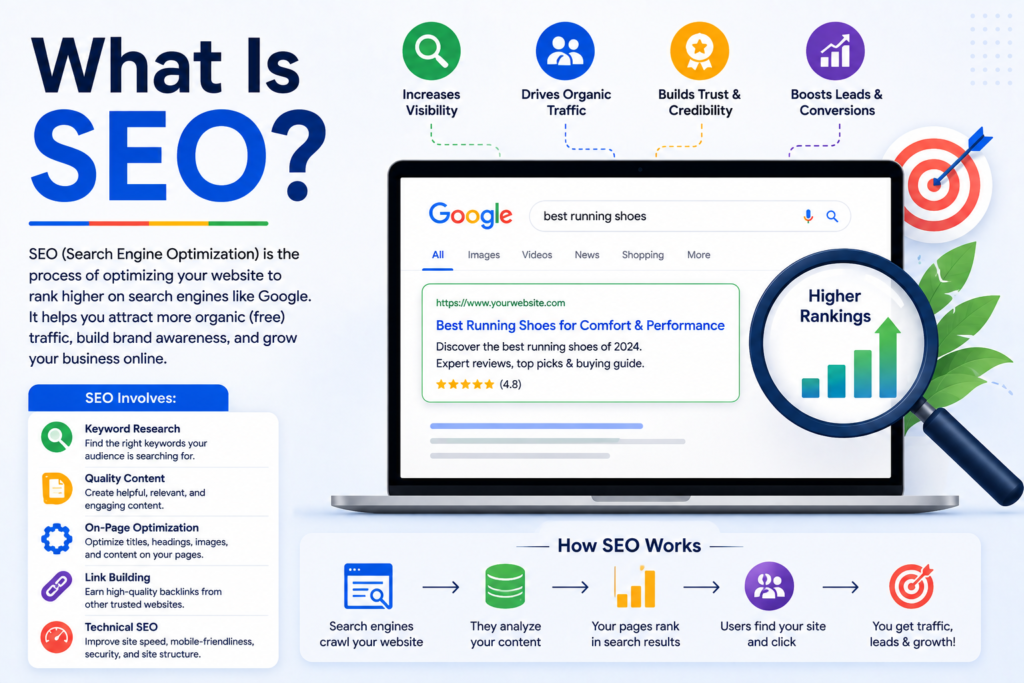
SEO stands for Search Engine Optimization.
Search engines such as Google use automated systems to discover, understand, and organize webpages. When someone searches for something, the search engine attempts to show the most useful and relevant results.
SEO involves making your website easier for both search engines and people to understand.
For example, imagine you have a website about digital marketing and publish an article called “How to Start Digital Marketing.” If someone searches for “how to start digital marketing,” good SEO can help your article become more visible for that search.
SEO is generally divided into three major areas:
- On-page SEO – Optimizing content and elements on your webpages.
- Off-page SEO – Building your website’s reputation through activities such as earning links and mentions.
- Technical SEO – Improving the technical structure and accessibility of your website.
These three areas work together to create a strong SEO foundation.
Why Is SEO Important?
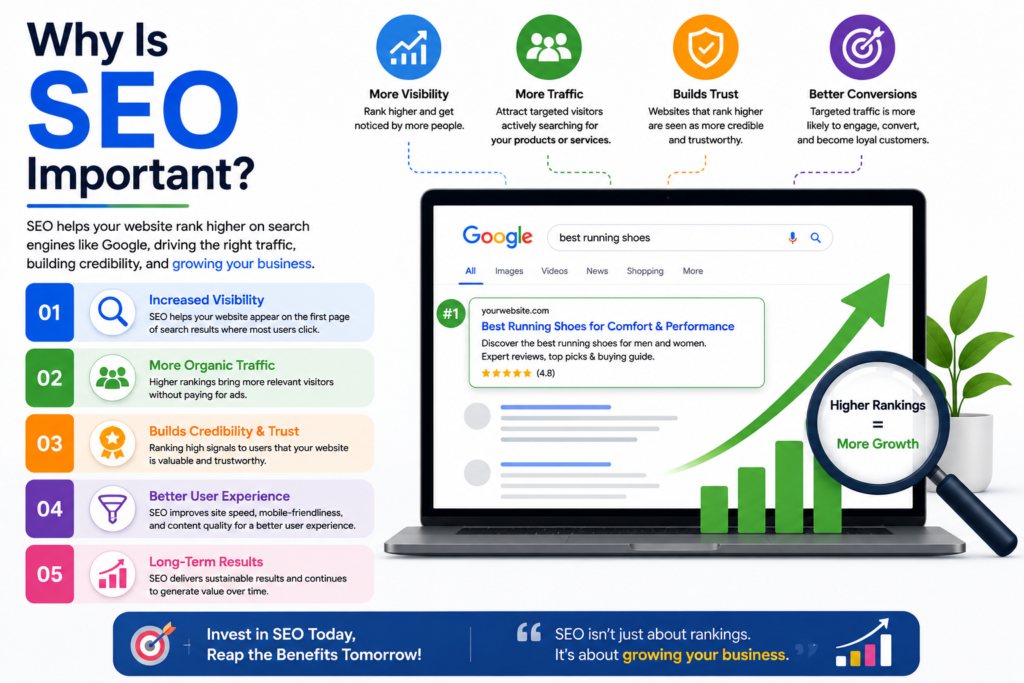
SEO can be valuable for websites of almost every type.
One of its biggest advantages is that it can bring organic traffic, meaning visitors who discover your website through unpaid search results.
Good SEO can help you:
- Increase website visibility
- Attract relevant visitors
- Build brand awareness
- Generate leads
- Increase online sales
- Establish credibility
- Reach people actively searching for information
Unlike advertising, where traffic can stop when you stop paying, SEO can continue bringing visitors as long as your pages remain useful, accessible, and competitive.
However, SEO is not an overnight strategy. It usually takes time to build authority and achieve consistent results.
How Does Google Ranking Work?
Before learning SEO techniques, it helps to understand the basic search process.
Google discovers webpages through crawling. It then processes and stores information about those pages through indexing. When someone performs a search, Google’s systems determine which indexed pages are most relevant and useful for that particular query.
Google considers many signals when determining search rankings.
Relevance is particularly important. Your page should clearly address what the searcher is looking for.
For example, someone searching for “best beginner photography tips” probably wants practical advice. A page that provides clear, useful photography tips is more relevant than a page that only mentions the phrase “photography tips” several times.
This is why modern SEO is about much more than inserting keywords into a webpage.
Step 1: Understand Search Intent
One of the first things beginners should learn is search intent.
Search intent refers to the purpose or reason behind a user’s search query.
Common types include:
Informational Intent
The user wants to learn something.
Examples:
- What is SEO?
- How does email marketing work?
- How to create a website?
Navigational Intent
The user wants to find a specific website or page.
Examples:
- YouTube
- Gmail login
- Nike website
Commercial Intent
The user is researching options before making a decision.
Examples:
- Best laptops for students
- SEO tools comparison
- Best website hosting
Transactional Intent
The user is ready to take an action, often making a purchase.
Examples:
- Buy running shoes
- Purchase web hosting
- Order headphones online
Before creating content, ask yourself: “What does the person searching this keyword actually want?”
Your content should satisfy that need.
Step 2: Perform Keyword Research
Keywords are the words and phrases people type into search engines.
Keyword research helps you discover what your target audience is searching for.
For beginners, start with specific and relevant phrases rather than trying to rank immediately for extremely broad keywords.
For example, instead of targeting:
“SEO”
you could target a more specific phrase such as:
“SEO tips for beginners”
or:
“how to improve SEO for a small business website.”
When researching keywords, consider:
- Relevance
- Search intent
- Competition
- Search volume
- Specificity
- Your website’s expertise
The goal is not to find keywords with the highest search volume. The goal is to find keywords that are relevant to your audience and realistic for your website.
Step 3: Create Helpful, High-Quality Content
Content is one of the most important parts of SEO.
Your website should provide genuinely useful information that answers users’ questions and solves their problems.
A strong article should have:
- A clear topic
- A useful introduction
- Logical headings
- Accurate information
- Practical examples
- Easy-to-read paragraphs
- Original insights
- A helpful conclusion
Avoid writing content simply to reach a particular word count.
A 1,000-word article that completely answers a question can be more valuable than a 3,000-word article filled with unnecessary information.
Think about the reader first and search engines second.
Step 4: Optimize Your Title and Headings
Your page title is an important part of on-page SEO.
A good title should clearly communicate what the page is about and encourage the right audience to click.
For example:
Weak:
“SEO Information”
Better:
“SEO for Beginners: A Complete Guide to Ranking on Google”
Use headings such as H2 and H3 to organize longer content.
For example:
- What Is SEO?
- Why Is SEO Important?
- How Does Google Ranking Work?
- Keyword Research
- On-Page SEO
- Technical SEO
- Common SEO Mistakes
Good headings improve readability and help search engines understand the structure of your content.
Step 5: Optimize URLs and Meta Descriptions
A webpage’s URL should be simple and descriptive.
For example:
example.com/seo-for-beginners
is easier to understand than:
example.com/page?id=2847
You should also create a useful meta description. A meta description summarizes the page and can help searchers understand what they will find when they click.
Keep it natural and relevant rather than filling it with keywords.
Step 6: Use Keywords Naturally
Keywords are important, but keyword stuffing is not.
Keyword stuffing means repeatedly inserting keywords into content in an unnatural way in an attempt to manipulate rankings.
For example, a sentence such as:
“SEO for beginners is important because SEO for beginners helps SEO for beginners learn SEO for beginners…”
is clearly poor writing.
Instead, use your main topic naturally throughout the article. Include related terms where they make sense.
Write for humans first.
Step 7: Improve Website Speed and Mobile Experience
Technical SEO is another important part of optimization.
Your website should be easy to use on different devices, especially smartphones.
Pay attention to:
- Page loading speed
- Mobile usability
- Website navigation
- Secure HTTPS connections
- Broken links
- Clear site structure
- Crawlability
- Accessibility
A website that is difficult to navigate can create a poor user experience even if its content is excellent.
Step 8: Build Internal Links
Internal links connect one page on your website to another page on the same website.
For example, if you write an article about SEO basics, you could link to another article about keyword research.
Internal linking can help visitors discover more useful content and can also help search engines understand the relationships between pages on your website.
Create links naturally using descriptive anchor text.
Instead of:
“Click here”
you could write:
“learn more about keyword research.”
Step 9: Earn Quality Backlinks
A backlink is a link from another website to your website.
Backlinks can help search engines understand that other websites find your content useful or trustworthy.
However, not all backlinks are equally valuable.
One relevant, editorially earned link from a reputable website can be more meaningful than hundreds of low-quality links.
You can naturally earn backlinks by creating:
- Original research
- Useful guides
- Helpful statistics
- Infographics
- Expert resources
- Unique tools
- High-quality educational content
Avoid buying large numbers of suspicious links or participating in schemes designed purely to manipulate rankings.
Step 10: Track Your SEO Performance
SEO requires measurement.
You should monitor how your website performs over time.
Useful metrics include:
- Organic traffic
- Search impressions
- Click-through rate
- Keyword visibility
- Conversions
- Engaged visits
- Indexed pages
Tools such as Google Search Console and Google Analytics can help website owners understand how people discover and interact with their websites.
Don’t panic if rankings change from one day to another. Search results can fluctuate.
Instead, look for longer-term patterns and focus on improving your website continuously.
Common SEO Mistakes Beginners Should Avoid
Learning what not to do is just as important as learning what to do.
1. Keyword Stuffing
Repeating keywords excessively can make your content difficult to read and may violate search-engine spam policies.
2. Copying Content
Simply copying content from other websites provides little value. Try to add your own expertise, examples, research, or perspective.
3. Ignoring Mobile Users
A website that works poorly on smartphones can create a frustrating experience.
4. Creating Content Only for Search Engines
If your article sounds unnatural because it was written only to target keywords, readers may leave quickly.
5. Expecting Immediate Results
SEO usually requires patience. Building useful content and earning trust takes time.
6. Chasing Every SEO Trend
SEO changes regularly, but you don’t need to follow every new tactic. Focus on fundamentals: helpful content, strong technical foundations, relevant topics, and a good user experience.
A Simple SEO Strategy for Beginners
If you’re completely new to SEO, don’t try to optimize everything at once.
Start with these steps:
Step 1: Choose a specific topic relevant to your audience.
Step 2: Research keywords and understand search intent.
Step 3: Create genuinely useful content.
Step 4: Optimize the title, headings, URL, images, and relevant on-page elements.
Step 5: Add internal links to related pages.
Step 6: Make sure your website works well on mobile devices.
Step 7: Promote your content naturally and work toward earning quality backlinks.
Step 8: Monitor performance and improve the page over time.
This simple process can provide a strong foundation for your SEO journey.
Conclusion
SEO may seem complicated at first, but its central idea is simple: create useful content for real people and make it easy for search engines to understand.
Successful SEO is not about finding a secret trick that instantly puts your website at the top of Google. It is about consistently improving relevance, quality, technical performance, credibility, and user experience.
Start with keyword research and search intent. Create helpful content. Optimize your webpages. Improve your site’s technical foundation. Build genuine authority and monitor your results.
Most importantly, be patient.
SEO is a long-term process, but when you consistently provide value to your audience, your website can build stronger visibility and attract more relevant organic traffic over time.